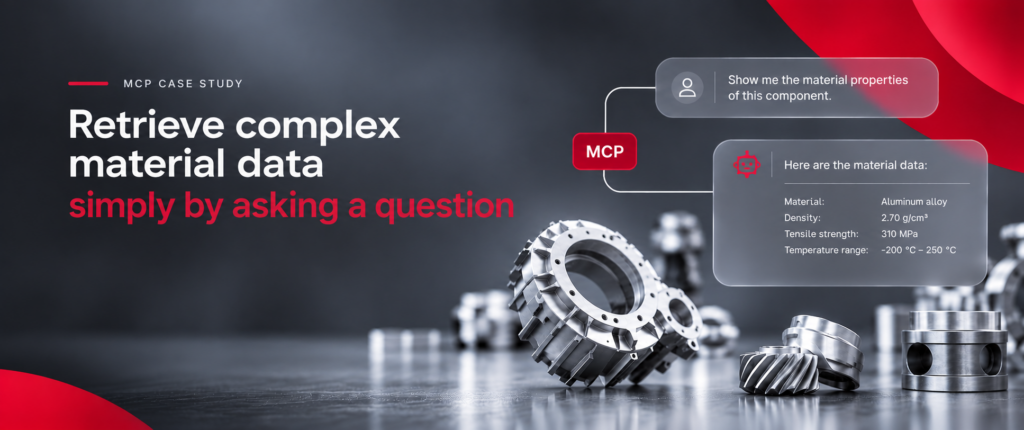
MCP Case Study: Retrieve complex material data simply by asking a question
A manufacturer of seals and technical plastic parts works with around 100 suppliers and 700 materials. Many materials can be exchanged between suppliers. Material compatibilities, certificates and availability make the data complex. A material management application with a REST API already exists. However, the connections within it were often not obvious at first glance, and using it correctly and economically required background knowledge and training. Inovum developed this application and then connected it to an AI assistant via MCP. MCP (Model Context Protocol) is an open standard that allows an AI to access an application securely. Since then, employees simply ask their questions in plain language.
What is MCP?
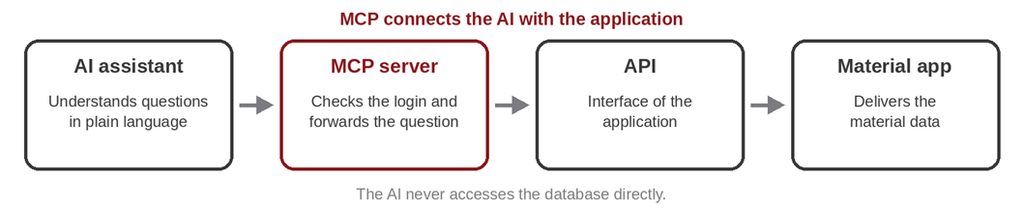
MCP stands for Model Context Protocol. It is an open standard. It defines how an AI accesses an application securely.
The MCP server sits between the AI and the application. It receives the AI’s question and passes it on to the application’s API. The API is the application’s interface. It fetches the data and sends it back. This is how API and MCP work together: the API delivers the data, and MCP makes it usable for the AI.
The opportunities and benefits of MCP:
- Simple: Employees ask in plain language.
- Secure: The AI only reads. Everyone logs in personally.
- No rebuild: The existing application stays as it is.
- Open: The standard works with different AI assistants.
The Customer
The customer is a manufacturing company from southern Germany with 120 employees. It produces seals and technical plastic parts and works in the areas of sealing technology, plastics technology, additive manufacturing and large-format manufacturing. It supplies only distributors and is certified to ISO 9001, ISO 14001 and ISO 50001.
| Industry | Seals and technical plastic parts, Germany |
| Data basis | Around 100 suppliers and 700 materials, some of which can replace each other |
| Technology | Model Context Protocol (MCP), OAuth |
| Access | Read-only, with personal login and roles |
| Implemented by | Inovum IT Solutions (application and MCP integration) |
Initial Situation and Problem
It is not easy for employees to keep track of materials, suppliers, certificates, resistances, biocompatibility and material compatibilities. The application knows all the data, but does not always show the connections at first glance.
| A lot of data | Hidden connections | Consequences in daily work |
|---|---|---|
| Materials, suppliers, certificates, resistances, biocompatibility and compatibilities must all be kept in view at the same time. | The application contains all the data, but does not show every connection immediately. Anyone who wants to use it correctly needs knowledge and training. | Purchases that were too expensive and faulty production caused by lack of knowledge happened regularly. |
Goals
Employees should be able to use the existing data more easily, without compromising data security. The suitable, most economical material should be found faster.
| Easier access | The existing data should be easier to use for all employees |
| Data security | High priority: read-only access, personal login, roles |
| Cost-effectiveness | Select the most economical material with the right properties and so relieve the purchasing budget |
| Quality | Fewer faulty productions and fewer customer complaints |
| Timeline | After six months, a first interim result is available |
Our Solution Approach
The application does not always show complex connections clearly. That is why we put an AI assistant at its side. Employees ask, in plain language, for example: “Which materials are suitable for food contact, withstand a temperature of over 50 degrees and have a valid certificate?” The assistant looks for the answer in the application’s data. It never accesses the database directly, only through the MCP server that Inovum built for this purpose.
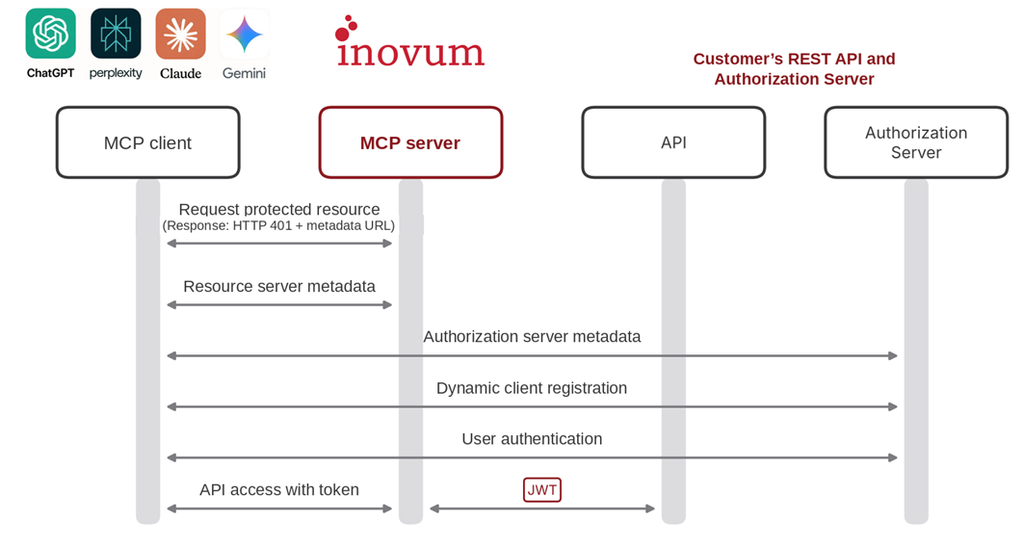
Three rules ensure security:
- Read only: The assistant cannot create, change or delete anything.
- Own account: Everyone logs in personally. The assistant only receives a time-limited access key (OAuth), never the password.
- Only with permission: Only users with an approved role can connect.
The Foundation: the Application
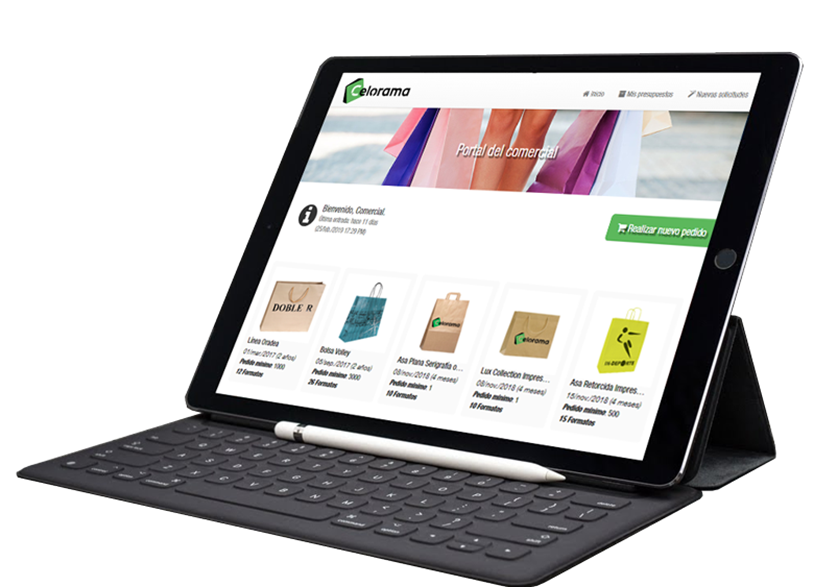
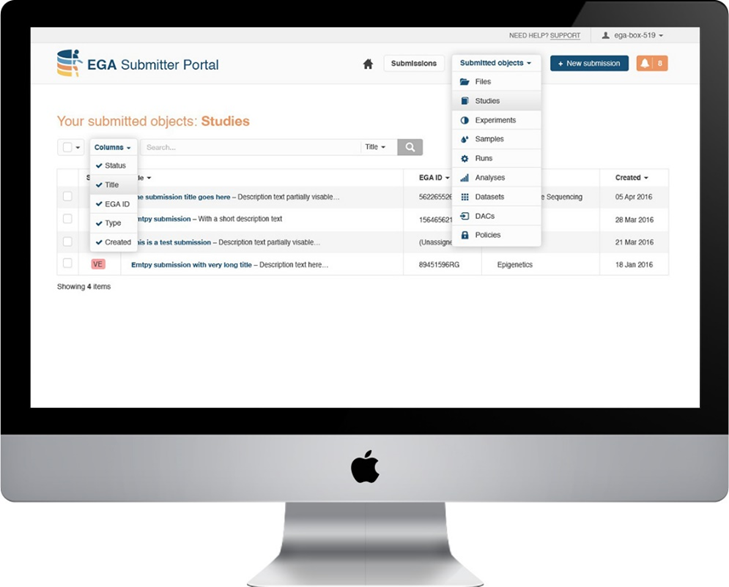
Inovum built the material management application in consultation with the customer and based on their requirements. The most important points:
| Data and approval | Certificates and dashboard |
|---|---|
| All changes are logged: who changed which record?The data comes from an existing databaseNew master data and materials are checked and approved by a technical administrator. Only then can users see them.Materials in the categories have validity dates that are linked to the certificates, | Suppliers receive an email when a certificate has expired and upload a new one. An administrator checks itA dashboard shows the administrator the user management and all open checks (materials, properties, standards, suppliers, categories, material groups, certificates)It also shows materials that have expired or will expire in x daysDuplicate records can be found and deleted |
Results after Six Months
- 5 % fewer customer complaints and incorrect orders.
- 2 % lower costs in material purchasing, even though inflation and prices rose sharply.
- All missing and expired certificates of the suppliers were found.
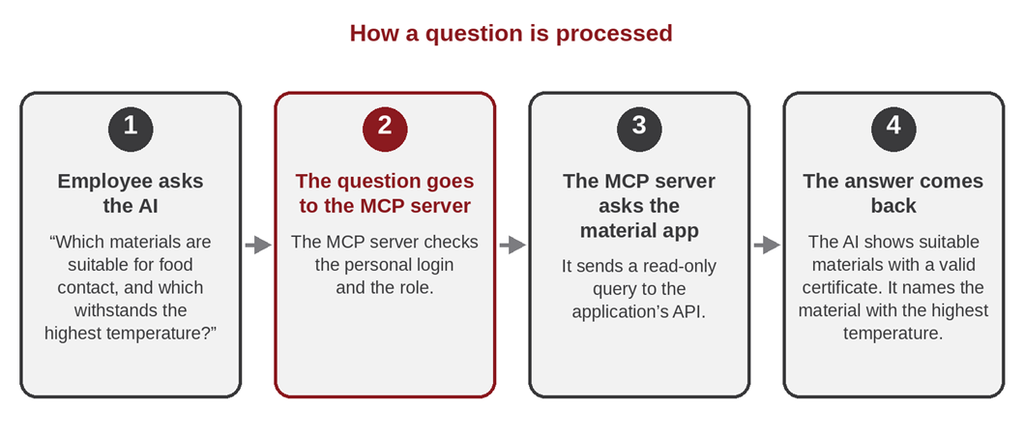
Questions such as “Which materials are suitable for food contact, and which one withstands the highest temperature?” are answered by the assistant with real data, without having to open several screens.
Conclusion and Outlook
Connections between materials that were barely visible before can now be seen. Employees like to query data, prefer using the application and find better solutions.
A residual risk remains: as soon as an AI such as ChatGPT, Claude or Gemini accesses company data, a security risk arises. Anyone who does not want this can use a local AI model instead.
Example: How it works
Want to know more? Book an introductory call with Franz Inselkammer, CEO of Inovum.
| PHONE | |
|---|---|
| info@inovum-solutions.com | Tel ES: +34 623 175 948 Tel DE: +49 (0) 8041 8085150 |

Comments are closed.